Google Pay
PaynoPain allows your business to offer Google Pay as a payment method to securely obtain your customer's card data and process the transaction.
Integration modes
1. Simple integration
The simplest and fastest option to implement.
In this mode:
- You configure the Google Pay button in your checkout.
- PaynoPain manages the entire payment flow:
- Merchant validation
- Authorization request
- Payment processing and capture
Configuration steps
- Access the PaynoPain dashboard.
- Go to Settings → Alternative Methods → Google Pay.
- Configure your business name and country, button style, and user information to collect according to your needs.
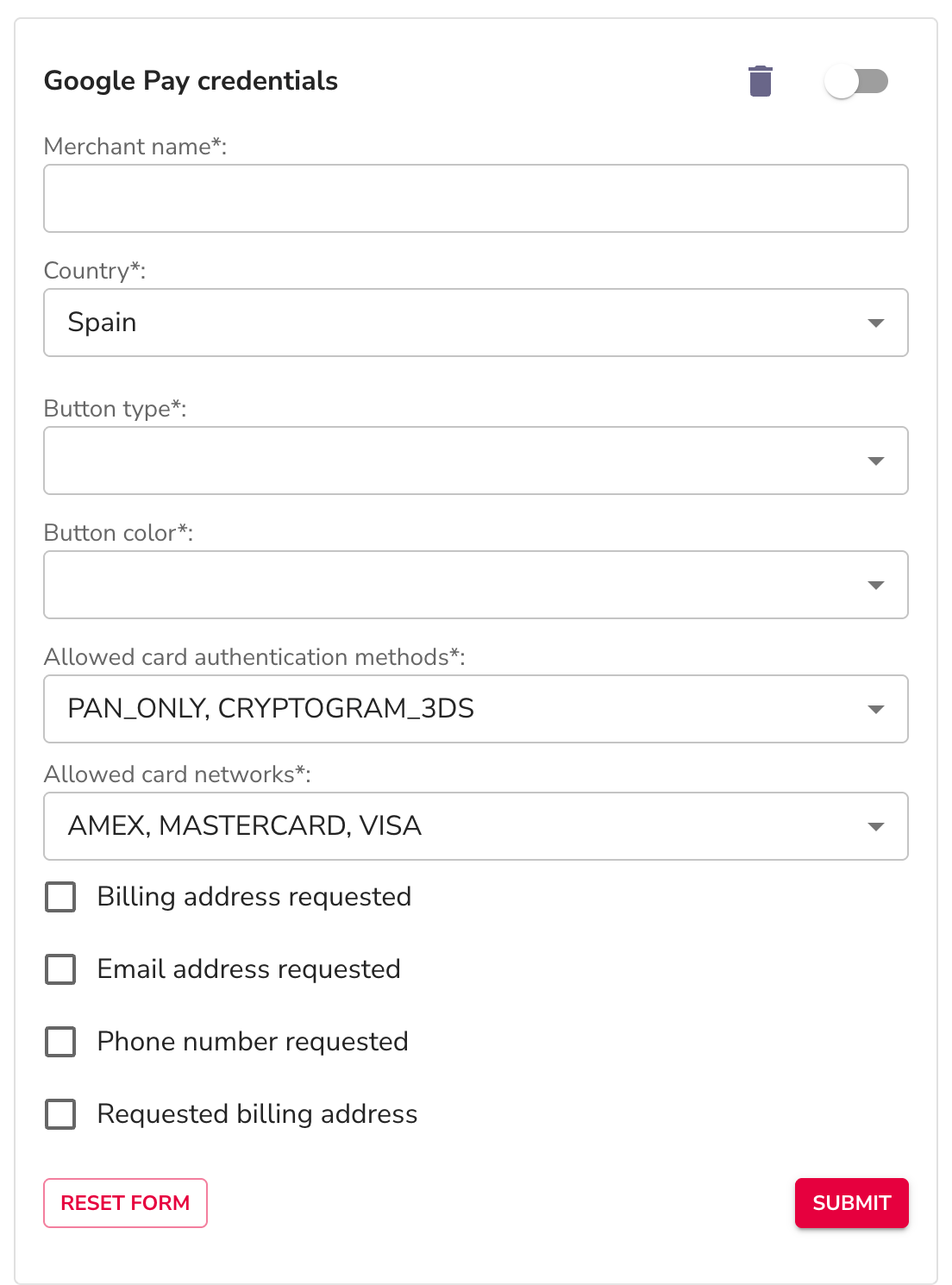
Once configured, customers will be able to pay with Google Pay through your checkout.
2. Advanced integration
Designed for: - Businesses that want to fully control their Google Pay integration.
⚠️ Prerequisites:
- Active account in the Google Pay Business Console.
- Business registered in Google Pay with the website host from where the payment process is initiated.
- Google Pay configuration in the PaynoPain dashboard.
- Integration of Google Pay in your website/app following the official documentation.
Technical flow
In this model:
- Your application requests payment authorization directly from Google Pay.
- Google Pay returns an encrypted payment token.
- Your backend sends that token to PaynoPain.
- PaynoPain processes the operation and returns the transaction result.
Configuration steps
In your Google Pay integration you must specify the following parameters:
gateway: paynopain
gatewayMerchantId: BFR+318Qe36w59SkUl2ECMRNJAfeW1e+Mv5r41/598MQjYHdZ0GfNK5CrRfSKYBCFj8eN7Uz5VG9+MgOoOSbXR8=
Which integration should I choose?
| Use case | Recommendation |
|---|---|
| Using PaynoPain checkout | Simple integration |
| Own web/app | Advanced integration |
| Need for full control of the flow | Advanced integration |
Configuration via API
If your merchant is a partner, in addition to configuring Google Pay from the panel you can do it for your merchants through the Configure Google Pay endpoint.
The request creates the Google Pay configuration of the merchant indicated in client_uuid if it did not have one, or updates it otherwise. The merchant must belong to the client making the request.
The fields sent are the same ones configured from the panel: the merchant name and country, the accepted card networks and authentication methods (allowed_card_networks, allowed_card_auth_methods), the button style (button_type, button_color) and the data to be requested from the user (email_required, phone_number_required, shipping_address_required, billing_address_required).
The Google Pay merchant identifier and the authorized origin are assigned by PaynoPain, so they are not sent in the request.
Example
{
  "signature": "121149a0ba5361191d740fa898784a8b",
  "client_uuid": "8dc780e8-c311-4791-a47f-c1a272ffbb87",
  "merchant_name": "Jhon Doe Shop",
  "country_code": "ESP",
  "allowed_card_networks": ["VISA", "MASTERCARD"],
  "allowed_card_auth_methods": ["PAN_ONLY", "CRYPTOGRAM_3DS"],
  "button_type": "PAY",
  "button_color": "BLACK"
}